The following article comes from Harvard Health Publications
Spending time outside might have some health benefits — and the ‘greening' of exercise might have some more.
Summer is the time when the outdoors beckons. We go to the beach in droves, have picnics and barbecues, paddle and fish and swim. Some hike, others bike, and a few do both — although not at the same time.
But these good times in the out of doors are really an exception to the rule, which is that most of us spend the vast majority of our time inside. According to one government estimate, the average American spends 90% of his or her life indoors, and as we get older we become even more inclined not to venture out.
When we do, there's a gantlet of precautions: slather on the sunscreen; take it easy — or head indoors — if air quality is bad; watch out for ticks, mosquitoes, and other creatures that might bite. It's all very well-meaning but it also reinforces indoor ways.
So it's back into the bunker — but that might not be good for you. The study results are ticking up: spending time outdoors seems to have discernible benefits for physical and mental health. Granted, some are merely by association and can be achieved by other means, perhaps while indoors, but often only with a good deal more trouble and expense. Here are five potential benefits of spending more time outdoors:
1. Your vitamin D levels will go up
Vitamin D is called the sunshine vitamin because sunlight hitting the skin begins the circuitous process — the liver and kidneys get involved — that eventually leads to the creation of the biologically active form of the vitamin. Over all, research is showing that many vitamins, while necessary, don't have such great disease-fighting powers, but vitamin D may prove to be the exception. Epidemiologic studies are suggesting it may have protective effects against everything from osteoporosis to cancer to depression to heart attacks and stroke. Even by conventional standards, many Americans don't have enough vitamin D circulating in their bodies. The good news is that you'll make all the vitamin D you need if you get outside a few times a week during these summer days and expose your arms and legs for 10 to 15 minutes. Of course, it has to be sunny out.
There are some snags. Vitamin D production is affected by age (people ages 65 and over generate about a fourth as much as people in their 20s) and skin color (African Americans have, on average, about half the levels of vitamin D in their blood as white Americans).
Another problem: sunscreens are most effective at blocking the ultraviolet B (UVB) light, the part of the spectrum that causes sunburn, but UVB also happens to be the kind of light that kick-starts the generation of vitamin D in the skin.
The either-or of sunscreen and sunshine vitamin has stirred up a lot of controversy and debate between pro-sunscreen dermatologists and the vitamin D camp. But there is plenty of middle ground here: some limited sun exposure on short walks and the like, supplemented with vitamin D pills if necessary, and liberal use of sunscreen when you are out for extended periods, particularly during the middle of the day.
2. You'll get more exercise (especially if you're a child)
You don't need to be outside to be active: millions of people exercise indoors in gyms or at home on treadmills and elliptical trainers. Nor is being outside a guarantee of activity. At the beach on a summer day most people are in various angles of repose.
Still, there's no question that indoor living is associated with being sedentary, particularly for children, while being outdoors is associated with activity. According to some surveys, American children spend an average of 6� hours a day with electronic media (video games, television, and so on), time that is spent mainly indoors and sitting down. British researchers used Global Positioning System devices and accelerometers, which sense movement, to track the activity of 1,000 children. They found that the children were more than doubly active when they were outside.
Adults can go to the gym. Many prefer the controlled environment there. But if you make getting outside a goal, that should mean less time in front of the television and computer and more time walking, biking, gardening, cleaning up the yard, and doing other things that put the body in motion.
3. You'll be happier (especially if your exercise is ‘green')
Light tends to elevate people's mood, and unless you live in a glass house or are using a light box to treat seasonal affective disorder, there's usually more light available outside than in. Physical activity has been shown to relax and cheer people up, so if being outside replaces inactive pursuits with active ones, it might also mean more smiles and laughter.
Researchers at the University of Essex in England are advancing the notion that exercising in the presence of nature has added benefit, particularly for mental health. Their investigations into "green exercise," as they are calling it, dovetails with research showing benefits from living in proximity to green, open spaces.
In 2010 the English scientists reported results from a meta-analysis of their own studies that showed just five minutes of green exercise resulted in improvements in self-esteem and mood.
Mind you, none of the studies were randomized controlled trials. The intuitive appeal of green exercise is its strength, not the methodological rigor of the research supporting it. It's hard to imagine how a stroll in a pretty park wouldn't make us feel better than a walk in a drab setting.
4. Your concentration will improve
Richard Louv coined the term "nature-deficit disorder" in his 2008 book Last Child in the Woods. It's a play on attention deficit hyperactivity disorder (ADHD). Researchers have, in fact, reported that children with ADHD seem to focus better after being outdoors. A study published in 2008 found that children with ADHD scored higher on a test of concentration after a walk through a park than after a walk through a residential neighborhood or downtown area. Other ADHD studies have also suggested that outdoor exercise could have positive effects on the condition. Truth be told, this research has been done in children, so it's a stretch to say it applies to adults, even those who have an ADHD diagnosis. But if you have trouble concentrating — as many do — you might see if some outdoor activity, the greener the better, helps.
5. You may heal faster
University of Pittsburgh researchers reported in 2005 that spinal surgery patients experienced less pain and stress and took fewer pain medications during their recoveries if they were exposed to natural light. An older study showed that the view out the window (trees vs. a brick wall) had an effect on patient recovery. Of course, windows and views are different than actually being outside, but we're betting that adding a little fresh air to the equation couldn't hurt and might help.
Source: https://www.health.harvard.edu/newsletters/Harvard_Health_Letter/2010/July/a-prescription-for-better-health-go-alfresco
© 2000-2010 Harvard University. All rights reserved.
Tuesday, July 20, 2010


Tuesday, July 13, 2010
Northern Virginia Waterparks

It has already been a summer season for the record books with temperatures in the 90's all the time.
In the last few years the Northern Virginia Regional Park Authority has become increasingly know as the place to go for summer fun, with all five of our waterparks sporting a new look, and new features. Enhancing the fun factor, NVRPA's waterparks all have themes that transport you to new, exciting places. The result of fresh newly renovated waterparks and record heat equals places that are more popular than ever before.
Collectively we have seen 40,000 more waterpark visitors this year than we have ever seen, and the summer is only half over!
- Great Waves at Cameron Run is the waterpark that you can see from the Beltway, right off of exit #174 on Eisenhower Road in Alexandria. In addition to speed slides, and twisty slides and many other features, the centerpiece is a giant wave pool (the only one in the area). Like ocean waves you can body surf, or ride one of the free inner tubes that are available. When you are hungry the Riptide Cafe has what you need. If you want to shop for some summer essentials, the Shark Shack has you covered. If the best waterpark in the region was not enough, Cameron Run also has mini-golf and batting cages, in addition to areas for your favorite events.
.JPG) Volcano Island is the newest waterpark to get a face lift and new features. This polynesian paradise is at Algonkian Regional Park in Sterling. Complete with giant dumping bucket, waterslides and a volcano on the roof, attendance at this site is up 70% from last year. This is a must see waterpark.
Volcano Island is the newest waterpark to get a face lift and new features. This polynesian paradise is at Algonkian Regional Park in Sterling. Complete with giant dumping bucket, waterslides and a volcano on the roof, attendance at this site is up 70% from last year. This is a must see waterpark.- Atlantis was lost for thousands of years and then we discovered it at Bull Run Regional Park in Centerville. Atlantis is an ancient Greek themed waterpark for those that like mermaids, Neptune, and lots of fun features including waterslides, buckets and more. As more people are discovering this great place the word is spreading and attendance is up over 50% for the second year in a row.
.JPG) Upton Hill in Arlington was revamped a few years ago with wonderful features including slides and more. Upton has an Outer Banks feel, for a laid back and fun summer day. This is a very popular destination.
Upton Hill in Arlington was revamped a few years ago with wonderful features including slides and more. Upton has an Outer Banks feel, for a laid back and fun summer day. This is a very popular destination.- Pirate's Cove is a favorite for buccaneers of all ages at Pohick Bay Regional Park in Lorton (Mason Neck). Cannons bristle and menacing flags fly as you approach Priate's Cove. Inside the fun continues and even includes buried treasure. The popularity of this great site has gone up 40% this summer.
.JPG)
.JPG)

Permitting for White's Ford is Done

After a number of steps including additional traffic studies, we will be able to open White's Ford Park (in 2011). In the initial phasing it will be a place where those with canoes & kayaks can do a car top launch. No trailers and no motorized boats, just a beach area to launch and paddle. The public will also enjoy the natural beauty and historical significance of this great property.
It is not open yet. And will need a number of further steps including creating an internal road, and the launch area, the end of farming, before it will be ready to launch boats and explore. In the next year we plan to plant many trees and convert some of the open fields into meadows that will attract birds, butterflies and other wildlife.
Historically, this is the site where the Confederate Army crossed the river on their way to Antietam in 1862.

Friday, July 02, 2010
Volcano Island Errupts at Algonkian
.JPG)
.JPG)
.JPG)
Korean Bell Garden Ground Breaking

This spring we planted over 100 trees native to Korea, put in stone terracing and steps, and a path through this area of the garden.
Earlier this week we had the ground breaking. One of the things that made this event even more meaningful was that this was the 60th anniversary of the Korean War. Many Korean War veterans attended as well as Mrs. Han the wife of the Korean Ambassador, Congressman Moran, State Senator Peterson, Fairfax Chair Sharon Bulova and Fairfax County Supervisors Penny Gross and Cathy Hudgins, and many others.

In addition to be a place of great beauty, it will be a cultural icon for tens of thousands of Korean Americans in our area, and a tourist attraction for Northern Virginia.
Tuesday, June 22, 2010
Holly Morris Reports Live from Fountainhead Park

Holly Morris with Fox 5 news pictured above paddling hard, reported live from Fountainhead Regional Park on the first day of summer. She did three segments, one on boating, one on mountain biking, and one on hiking.
Here is a link to the video of Holly's morning of fun at Fountainhead Regional Park on the Occoquan Reservoir. http://www.myfoxdc.com/dpp/mornings/holly_live/holly-morris-first-day-of-summer-062110
Fountainhead is a great place to rent a boat and explore the reservoir. It also boasts the best mountain biking trail in the mid-Atlantic. And it is the trailhead of the Bull Run/Occoquan Trail that goes 18 miles to Bull Run Park. If you love the outdoors, Fountainhead is the place for you!
Monday, May 17, 2010
Challenges for White's Ford Regional Park
.JPG)
Recently, the Board of Supervisors approved the “Commission Permit,” which allows it to become a public facility, but sent two other permits, one for a boat launch for canoes and kayaks and one for camping, back for further review by the Land Use and Transportation Committee of the Board. Since then we have agreed to further reductions in use and other conditions.
Park Uses:
Most people would think that a park is a universally good thing. The issue is park uses. There is a group of around thirty people who are landowners near the site and friends and family of those neighbors who are opposing the public uses.
All that has ever been proposed for this site is boat launching, picnicking, camping, occasional special events, trails and historical interpretation - all uses that are considered by most to be “passive.” This is opposed to athletic fields, water parks, performing arts venues and other recreational uses that draw large number of people at certain times.

The road leading to the park, Hibler Road, is a rural gravel road. Much has been said about the transportation challenge that this poses. One of the challenges is that the permitting process for a park is the same as it is for a residential or commercial development. The big difference for a park is the pattern of road usage. Parks are not used heavily on weekday mornings or evenings (rush hours) like other uses. Parks are used mostly on weekends when other road travel is more spread out. The uses we are proposing are also not the kind of uses that will draw large groups at the same time.
It is important to think about why we create parks. We do this to offer places for the public to go and engage in wholesome outdoor activities. Fishing, boating, camping and hiking as well as historic tourism are all important.

In 2007, we asked a firm to poll/survey Loudoun County residents about park uses, and the results strongly support a White’s Ford Park with the uses we have proposed.
- 59% had a need for natural areas.
- 59% had a need for historic sites.
- 58% had a need for picnic shelters and areas.
- 46% had a need for unpaved trails.
- 30% had a need for campgrounds.
- 25% had a need for boat launch & rental sites.
- 21% had a need for cabin rentals.

The smallest of these percentages represents nearly 20,000 households in Loudoun County, yet around 30 citizens interested in keeping people out are having a disproportionate influence. Unfortunately, since the park does not exist yet, it does not have a constituency that has grown to use and love the park, and is willing to speak up for it.
History and Archeology:
During the process, some people have suggested this is a bad location because they are looking at it from the perspective of roads. But roads are not the most important factor in selecting land for parks. When we analyze properties for parks, we look at factors like access to water, historic significance, trail potential and others. White’s Ford is an outstanding property from a park perspective.
The biggest historic event to take place there was the crossing of the Confederate Army from Virginia to Maryland, shortly after the Second Battle of Manassas, on their way to the Battle of Antietam. General Stonewall Jackson and Colonel Elijah White scoped out all the potential crossing points along the Potomac and selected this as the best site. In addition, the site still has the house where Elijah White and his family lived before and during the war. We specialize in historic sites at the Northern Virginia Regional Park Authority and are always looking for locations with rich history to preserve and interpret.

We have also done extensive archeological work on the site and discovered evidence in a number of locations that tell the story of Native American people who lived near the river. We have carefully planned park amenities to avoid these locations, yet the opponents like to suggest we are insensitive to the history. It is precisely because of these features that this land should be a park.
Environmental Protection:
The opponents have also made a lot of noise about how this park will somehow be an environmental problem. This line of thought is without any merit. Currently, the land has two uses. Next to the river it is plowed and planted in row crops, and the upland portion of the land is being used to graze cattle. There are very few trees on the property, other than directly along the river bank and along the one stream valley on the property. One can assume that the row crops by the river are likely being sprayed with fertilizer and/or pesticides. In short, the current condition of the land is less than ideal.
We are proposing to convert most of the land to forest and meadows that will substantially improve the habitat value of the land. We have worked with the Loudoun Wildlife Conservancy on this plan, and they are supportive of our plans.

Along the river, we have agreed to a 200 foot riparian (forested) buffer. This is twice the buffer that would be required under Chesapeake Bay Resource Protection Areas.
Some of the neighbors have spoke at every opportunity about the threat of shoreline erosion that they believe will come with trails and park usage. While the concern about erosion is noble, there is a great misunderstanding about cause and effect on this issue. In November of 2009, Williamsburg Environmental Group studied the impact on shoreline impact from boating and trail use and found that the shoreline was in good condition at numerous park locations along the Potomac, and there was no evidence that trails or boating posed a threat to the shoreline. I am sure no amount of research will convince some, but it is important that the broader community have a clear understanding that well managed hiking trails and boat launch areas pose no threat to the integrity of the shoreline.
The Northern Virginia Regional Park Authority has over 100 miles of trails; 35 of those miles are hiking/equestrian trails that parallel the Potomac, Bull Run and Occoquan Rivers. We own and manage over 8,000 acres of river front property.
Making White’s Ford a park will have tremendous ecological value.
Conclusion:
The Regional Park Authority has managed parks for over 50 years. We are a regional leader in conserving historic resources, and a national leader among park agencies in progressive environmental policies. We have extensive experience managing trail networks, family campgrounds, water access points and other features.
Up to now, we have kept our focus on the legal and land use issues related to the permits we were seeking. As public officials, it is our job to have thick skins and not worry too much if a few choose to oppose what is going to be good for the general public. However, by not addressing the issues the opponents have been putting out, some may think that those claims have merit. The purpose of this piece is not to disparage any individual who chooses to oppose White’s Ford Park or the uses of the park (everyone has a right to an opinion), but to set the record straight on a number of issues that we have not addressed as clearly before.
Friday, May 14, 2010
Making Parks Look Great

I am very proud of the efforts of our park staff and I think all the hard work is very apparent. In the last 3-4 years all of our parks have seen a significant improvements in their appearance.
If you enjoy your parks, thank a park employee when you see them doing their job.
Wednesday, May 12, 2010
Bike to Work on May 21st
Bike to work day is coming up and according to the Washington Area Bike Association around 1,000 people a year are joining this annual day which sees in excess of 8,000 people a year peddling to work.
Nearly 6% of the population of Portland Or commute on their bikes on a regular basis (and it rains a lot there). As more people in our area choose to the bike instead of the car to go places, the social and personal benefits are great. On the community level our road become less clogged, and our air becomes cleaner. On the person level, cycling is fantastic exercise.
The Fairfax Times just ran a great story about the bike to work trend which you can see at: http://www.fairfaxtimes.com/cms/story.php?id=1493
In this story Charles Strunk Fairfax County Bicycle Program Coordinator notes "the Washington & Old Dominion Trail sees the highest commuter traffic, and even experiences a "rush hour" effect on weekday mornings and evenings. "The W&OD is like the I-66 for bikers," Strunk said of the 45-mile trail that extends from Purcellville to Arlington."
We are very proud to be able to offer the backbone of so many cycling trips that use the W&OD Trail as part of the journey.
For those interested in biking places, Google Maps has just recently added a feature where you can search out the best route between point A and point B that would work for a bike.
 Whether your trip is to work, the local store, or an area park, plot out your course and go there via peddle power. In addition to being good for you and the world, it is a lot of fun!
Nearly 6% of the population of Portland Or commute on their bikes on a regular basis (and it rains a lot there). As more people in our area choose to the bike instead of the car to go places, the social and personal benefits are great. On the community level our road become less clogged, and our air becomes cleaner. On the person level, cycling is fantastic exercise.
The Fairfax Times just ran a great story about the bike to work trend which you can see at: http://www.fairfaxtimes.com/cms/story.php?id=1493
In this story Charles Strunk Fairfax County Bicycle Program Coordinator notes "the Washington & Old Dominion Trail sees the highest commuter traffic, and even experiences a "rush hour" effect on weekday mornings and evenings. "The W&OD is like the I-66 for bikers," Strunk said of the 45-mile trail that extends from Purcellville to Arlington."
We are very proud to be able to offer the backbone of so many cycling trips that use the W&OD Trail as part of the journey.
For those interested in biking places, Google Maps has just recently added a feature where you can search out the best route between point A and point B that would work for a bike.

Monday, April 26, 2010
Loudoun County Could Add Park At Potomac River
.JPG) White's Ford is the land on the left side of the river.
White's Ford is the land on the left side of the river.Below is a link to an article from Civil War News about the efforts to create White's Ford Regional Park on the banks of the Potomac River.
Thursday, April 08, 2010
Women Golfers

The Wall Street Journal recently published and article by John Paul Newport on women and golf. The article was called Golf Searches for Its Feminine Side.
This story is about new studies that look at what women are looking for in golf, and how courses could change to attract more women to this sport that is currently made up of about 22% women golfers.
The article states:
"The new research details a disturbing disconnect between what golf facilities perceive as important to women and what actually is. For example, course operators vastly underestimate the significance to women of top-notch conditions, speed of play and length of holes. They tend to trivialize concerns such as having adequate drinking water and clean bathrooms on the course, clear directional signage and tee markers, well-stocked women's merchandise sections in the pro shop and friendly, welcoming staff atuned to women's needs."
We operate three golf courses at the Northern Virginia Regional Park Authority: Algonkian, Brambleton, and Pohick Bay. I am sure we can improve the experience for women golfers at our courses, and we will be looking at these studies to see what we can do.
In the last few years we have been improving our courses with an eye to attracting more women golfer in addition to retaining our current base of golfers. We have improved the forward tees at some of our courses, and encouraged more leagues to make the game more social. While not specifically a female golfer issue, we have significantly ramped up our environmental commitment at all three of our courses. We were actually the first publicly owned courses in the Mid-Atlantic region to obtain Wildlife Sanctuary status for our courses through Audubon International. This greening of our greens can can give our golfers and the general public peace of mind that we are proactively protecting water quality, reducing chemical usage and enhancing wildlife habitat.
to read this Wall Street Journal article click on: www.wsj.com/article/SB10001424052748704094104575143772046834464.html
Tuesday, April 06, 2010
Virginia is For History
 Images from Balls Bluff Battlefield

What do you think of first when it comes to Virginia as a travel destination?
If you are like the hundreds of travelers that were interviewed by the Virginia Tourism Corporation in their 2009 Attitude Study the answer was History. 37% of those asked responded with historic sites, the highest ranked category for this question.
This presents a huge opportunity for tourism in 2011 which is the 150th anniversary of the Civil War. Already groups and individuals are booking their reservations to come to Northern Virginia to see the many sites of significance to the Civil War.
This was not only America's most deadly war, it did as much to define America as the Revolution had. To understand American history means to understand the Civil War.
Particularly during the first half of the war, Northern Virginia was at the center of the conflict. The first battle of Manassas was the first real battle of the war. Ft. Sumter where the first shots were fired was an artillery bombardment with on casualty that happened after the main bombardment was over. Manassas was the first time the armies of the north and south face off against each other. A few months later the Battle of Balls Bluff near Leesburg brought home the political reality that this was going to be a long hard fought war.
Then in 1862 there was the Second Battle of Manassas, the Battle of Ox Hill (or Chantilly). There was also the Battle of Dranesville and the Battle of Aldie, all in Northern Virginia. Arlington and Alexandria Virginia were armed camps with forts ringing the Nations Capital. All along the Bull Run and Occoquan Rivers were numerous forts and camps that were used by both sides as the lines of control shifted.
Northern Virginia was the base of operations for the most famous scout and partisan ranger of all times, John S. Mosby, who carried out his hit and run raids all over the region from 1863 -65.
60% of the combat of the Civil War was fought in Virginia. And with so much of the action centered in the Northern Virginia area outside of Washington D.C. this is one of the best possible destinations for historic tourism.
Beyond the Civil War, this area also boasts some of the best colonial historic sites anywhere with places like Mt. Vernon, Gunston Hall and the Carlyle House and many other sites to educate and entertain visitors.
With all of these resources it is little wonder that Virginia is for History.
Monday, March 29, 2010
Revenue Development & Managment School
 I recently returned from the NRPA (National Recreation and Park Association) Revenue Development and Management School at Oglebay Resort in West Virginia. This is a professional development school that is celebrating its 45th year. What it really amount to is a business school for park professionals.
It is a week long school with a two year curriculum. To assure that it maintains high academic standards Dr. Phil Rea, the former Director of the Park & Rec Program at North Carolina State University, advises the school.
In the course of the two year program students learn everything they need to put together a comprehensive business plan for a new or significantly changed park, or program. The capstone project is a written business plan that teams of 5-6 students put together and then they stand before a mock City Council and do a power point presentation where they lay out their plan and field questions. It is fantastic real world experience.
I have the honor of being one of seven Regents for the school. The Regents are park directors that serve as both the board of directors for the school as well as the instructors. The Regents are greatly helped by two leading professional that are selected as "externs" as well as Dr. Rea. This year I taught classes on developing marketing plans, innovation, as well as co-taught a class in contracting services and co-lead the first year student’s project.
Both first and second year classes were great. The parks professional that are sent to this program by their agencies are the top notch go-getters that are looking to hone their business skills to advance their agencies and invest in their own careers, and professional development.
In my planning for the course on marketing, I ran across a quote from Dr. John Crompton a leading thinking in the park field. Crompton was recounting how shortly after he came to the US from England, he was asked to give a presentation on marketing at one of the national conferences for park officials and almost no one showed up, not understanding what marketing had to do with parks. That was 1976.
Today the successful park agencies are the ones with good business acumen. In addition to the greater need to generate non-tax dollar funds for operations, there are simply many more ways for the public to spend their leisure time than in the past. If we are going to attract the public to spend more time outside engaged in healthy activities, we need to sell what we have to offer and not assume that the public will simply “find” our parks and facilities as they have in the past.
Interestingly even in a year when most public park agencies have been cutting their training budgets in reaction to the recession, the Revenue School saw significantly increased attendance this year. I think this reflects the understanding that many park agencies are developing that to succeed they need to know how to run their operations in an increasingly professional and business like manner.
For more information on the Revenue Development and Management School see the web site for the school at: http://www.revenueschool.org/about.html
Thursday, March 25, 2010
Udall and Regional Parks

Stewart Udall Looking for Future Parkland from a Helicopter
Stewart Udall recently passed away. The Secretary of the Interior during the Kennedy/Johnson years is best know for saving large areas of the West and expanding National Parks.
A story that has not been told is his role in growing regional parks outside of Washington D.C. in Northern Virginia.
Walter Mess Chairman Emeritus of the Northern Virginia Regional Park Authority who is now 97 years old told me some of this story just this week. And Rob Hartwell, son of our former Vice Chair Elizabeth Harwell confirmed the details.
Udall often traveled via helicopter because it offered such a great view of the land. Around 1964 or 65 a group of dignitaries were going to meet Secretary Udall at Ft. Belvoir in Fairfax County Virginia for a helicopter tour of Northern Virginia. Walter Mess and Elizabeth Hartwell who was the Vice Chair of the Northern Virginia Regional Park Authority at the time were determined to get Udall's ear about land conservation. 

Walter served in both the European and Burma/China theaters of WWII in the OSS (predecessor to the CIA) so he had military credentials to get Liz Hartwell and him on the base. They got on the helicopter before the rest of the group and as they began flying around Northern Virginia, Hartwell and Mess began telling Secretary Udall all about the land that they there flying over and their efforts to acquire the most sensitive areas as regional parks. A bond was formed and Stewart Udall went on to help the Northern Virginia Regional Park Authority with millions in land acquisition funding that helped purchase many of the Regional Parks like Pohick Bay, the land along the Occoquan and the W&OD Trail, in the years that followed.
As we enjoy these places today, it is interesting to think that we may only know a little about the perseverance, dedication, and energy that it took to make these areas parks in the first place.
Just about every park has a story and a hero or two that helped to make that area a place where the public can engage with nature.


Elizabeth Hartwell and Walter Mess
Friday, March 05, 2010
New Parkland at Gilbert's Corner

At the January Board Meeting of the Northern Virginia Regional Park Authority the new parkland that NVRPA has been acquiring in Loudoun County received its new names.
The historic Mt. Zion Church property on the south side of Rt. 50 will be called "Mt. Zion Historic Park." This building was built in 1851 and served as a hospital after the Battle of Aldie during the Civil War. It was also the first rendezvous site for Mosby's Rangers and one that they used numerous times.
The land to the North of Rt. 50 is called "Gilbert's Corner Regional Park" and includes 155 acres of rolling country side.
Less than one mile away is Aldie Mill Historic Park which NVRPA acquired in 2006 from the Virginia Outdoor Foundation.
Reflecting on the Park Needs survey we did in 2007, it told us that the number one park and recreation desire of the public was to acquire more parkland and open space. In the same survey 75% of the public express a great need for trails and 59% had a need for historic sites. In a similar study conducted by the Commonwealth in 2006 (Virginia Outdoor Survey), "walking for pleasure" and "visiting historic sites" were to two most popular outdoor activities of the public. We certainly are preserving a lot of important history with these properties and one of our goals is to expand our trail network in this area. Building on the system of over 100 miles of trails we currently have.
Wednesday, February 24, 2010

Providence Smith of Wakefield High School is the winner of the annual contest for the photo that will represent Arlington County on their vehicle sticker. The image is that of a snowy day on the W&OD Trail. I am sure the record snow fall this winter helped influence the judges.
The W&OD Trail is a wonderful symbol for Arlington. Arlington County was one of the founding members of the Northern Virginia Regional Park Authority fifty years ago. The W&OD Trail which the Regional Park Authority created from the old Washington and Old Dominion rail line was developed in the late 1970's and early 1980's.
Today this trail runs through the heart of Arlington County and far beyond. At 45 miles, the W&OD Trail is one of the longest parks. As a paved path for biking, walking, rollerblading and horseback riding, this trail through some of the densest areas of Northern Virginia offers one of the best options for non-motorized transportation.
Arlington County has long been a leader in environmentalism and a big part of the mix is to encourage people to make more trips without their cars. With the W&OD Trail these trips become more practical.
We congratulated Providence Smith on her wonderful photo, and we thank Arlington County for seeing the value of making the W&OD Trail a symbol of what is best about the County.
Tuesday, December 22, 2009
Mosby & Forbes July 6, 1864
24 Hours of Loudoun County History
On the 5th - 6th of July, 1864, Union and Confederate cavalry forces played a game of “cat and mouse” across Loudoun County and ended in a deadly confrontation at Gilbert’s Corner. The events of this 24-hour period bring in the interconnected histories of Regional Parks, including Temple Hall Farm, Aldie Mill, Ball’s Bluff, the new Regional Park in and around Mt. Zion (Gilbert’s Corner), and White’s Ford, which may be the next park in the Northern Virginia Regional Park system.
From the summer of 1863 to the summer of 1864, the dynamics of the war had changed. In the summer of ’63, Lee’s Army was on the offensive and seen as largely invincible. The Battle of Aldie had occurred that summer, as a result of the Confederate Army moving north towards Gettysburg. Gettysburg changed everything, and Lee’s Army was now in trench warfare outside of Petersburg, with Grant using the superior resources of the Union to crush Lee’s Army.
In an effort to shake up the dynamics of the war and cause the Union to pull troops away from Petersburg, Lee sent General Early on a mission to attack Washington.
So, it was in this setting that Col. John S. Mosby, famous Confederate Ranger, received word to assemble his force and disrupt communications between Washington and Harpers Ferry to assist with Early’s offensive. When Mosby put out the call for troops, he never knew whether he would wind up with fifty soldiers or three hundred and fifty. While he had a small group of regulars, many of those that came to join him were Confederate soldiers on furlough that were in the area. When he assembled his group in Upperville on July 3rd, they were 250 strong and even had one cannon. On the 4th and 5th of July, they attacked the Union base across the river at Point of Rocks. They cut the telegraph wires that ran between Washington and Harpers Ferry, and left with a number of wagons full of Union supplies. The battle at Point of Rocks included a victory by Mosby’s forces over the Loudoun Rangers, a group of Union Cavalry that came largely from the Waterford area.
On the evening of the 5th of July, Mosby ate dinner at Temple Hall Farm, home of Henry Ball. Ball had fought at the Battle of Ball’s Bluff three years earlier at the beginning of the war, and was unboundedly familiar with many in Mosby’s party. Elizabeth White, wife of Confederate Cavalry officer Elijah White, was living with her neighbors at Temple Hall Farm.
One of the interesting events of July 5, 1864 is that at the same time Mosby’s troops were camped in and around Temple Hall, the women of Temple Hall, Elizabeth White, Bettie and Kate Ball and their friend Annie Hempstone, went across the river at White’s Ford and were arrested. These women had been identified crossing the river the previous fall and summer without permission and were suspected of being spies. Major Thompson of the 2nd Massachusetts Cavalry noted “these ladies are bitterly hostile to the U.S. Government, have near relations in the Rebel Army, and are eminently disposed and capable of doing much injury to the Union Cause.” These friends were taken to Washington and held in the Capital Prison. Annie Hempstone wrote years later that they were actually on a mission to smuggle clothes and boots for some members of Elijah White’s 35th Battalion of the Virginia Cavalry who had family in Maryland. And, that after being released from prison, these women came back into Virginia with the boots and clothes tied up in their hoop skirts.
From the summer of 1863 to the summer of 1864, the dynamics of the war had changed. In the summer of ’63, Lee’s Army was on the offensive and seen as largely invincible. The Battle of Aldie had occurred that summer, as a result of the Confederate Army moving north towards Gettysburg. Gettysburg changed everything, and Lee’s Army was now in trench warfare outside of Petersburg, with Grant using the superior resources of the Union to crush Lee’s Army.
In an effort to shake up the dynamics of the war and cause the Union to pull troops away from Petersburg, Lee sent General Early on a mission to attack Washington.
So, it was in this setting that Col. John S. Mosby, famous Confederate Ranger, received word to assemble his force and disrupt communications between Washington and Harpers Ferry to assist with Early’s offensive. When Mosby put out the call for troops, he never knew whether he would wind up with fifty soldiers or three hundred and fifty. While he had a small group of regulars, many of those that came to join him were Confederate soldiers on furlough that were in the area. When he assembled his group in Upperville on July 3rd, they were 250 strong and even had one cannon. On the 4th and 5th of July, they attacked the Union base across the river at Point of Rocks. They cut the telegraph wires that ran between Washington and Harpers Ferry, and left with a number of wagons full of Union supplies. The battle at Point of Rocks included a victory by Mosby’s forces over the Loudoun Rangers, a group of Union Cavalry that came largely from the Waterford area.
On the evening of the 5th of July, Mosby ate dinner at Temple Hall Farm, home of Henry Ball. Ball had fought at the Battle of Ball’s Bluff three years earlier at the beginning of the war, and was unboundedly familiar with many in Mosby’s party. Elizabeth White, wife of Confederate Cavalry officer Elijah White, was living with her neighbors at Temple Hall Farm.
One of the interesting events of July 5, 1864 is that at the same time Mosby’s troops were camped in and around Temple Hall, the women of Temple Hall, Elizabeth White, Bettie and Kate Ball and their friend Annie Hempstone, went across the river at White’s Ford and were arrested. These women had been identified crossing the river the previous fall and summer without permission and were suspected of being spies. Major Thompson of the 2nd Massachusetts Cavalry noted “these ladies are bitterly hostile to the U.S. Government, have near relations in the Rebel Army, and are eminently disposed and capable of doing much injury to the Union Cause.” These friends were taken to Washington and held in the Capital Prison. Annie Hempstone wrote years later that they were actually on a mission to smuggle clothes and boots for some members of Elijah White’s 35th Battalion of the Virginia Cavalry who had family in Maryland. And, that after being released from prison, these women came back into Virginia with the boots and clothes tied up in their hoop skirts.
 A Photo of the Women of Temple Hall Farm shortly after they were released from Prison. They are Posing with Col. Elijah White (with sword) and some of his officers.
A few hours after the women were arrested on the Maryland side of White’s Ford, Mosby heard the news that Union Cavalry forces under the command of Major Forbes were nearby in Leesburg.
Forbes’ forces, based out of Falls Church, were on a scouting mission of the Aldie area. After riding up Rt. 50 (known at the time as Little River Turnpike) and finding all quiet in Aldie, they proceeded up Rt. 15 to Leesburg, where they heard the news of Mosby’s raid on Point of Rocks, but did not know where his forces were.
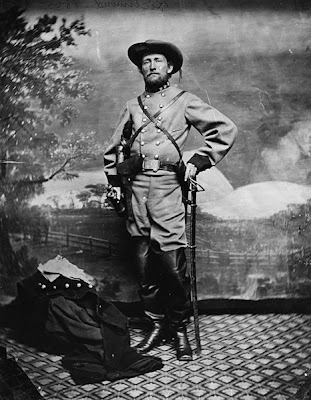
John S. Mosby
Mosby moved his group to the Waterford area for the night and laid his plans to engage Forbes the next day. Knowing that Forbes was likely to retrace his steps and go back to Aldie before turning east to head towards their base, Mosby headed out in the morning of the 6th to get ahead of Forbes and ambush him along Rt. 50. From Leesburg, Mosby took the Carolina Road following the path of modern day Evergreen Mill Road. On the south side of Goose Creek, he took a route that brought him to Rt. 50, near what is Lenah Farm Road today.
Forbes’ group stopped at the field across the road from Mt. Zion Church (the property recently acquired by the Regional Park Authority) for several hours to make dinner. Growing impatient for the Union Cavalry to move towards his trap, Mosby’s force moved west to find Forbes.
The two forces were roughly equally matched with about 150 mounted cavalry each. As the Union forces saw the approaching Confederates, Forbes lined most of his group up on the south side of the road, with his advance guard on the north side. The first shot was fired by the one cannon Mosby had, which was in the middle of the road. The Union forces returned fire with rifles. Then the Confederates gave a yell and charged.
Mosby moved his group to the Waterford area for the night and laid his plans to engage Forbes the next day. Knowing that Forbes was likely to retrace his steps and go back to Aldie before turning east to head towards their base, Mosby headed out in the morning of the 6th to get ahead of Forbes and ambush him along Rt. 50. From Leesburg, Mosby took the Carolina Road following the path of modern day Evergreen Mill Road. On the south side of Goose Creek, he took a route that brought him to Rt. 50, near what is Lenah Farm Road today.
Forbes’ group stopped at the field across the road from Mt. Zion Church (the property recently acquired by the Regional Park Authority) for several hours to make dinner. Growing impatient for the Union Cavalry to move towards his trap, Mosby’s force moved west to find Forbes.
The two forces were roughly equally matched with about 150 mounted cavalry each. As the Union forces saw the approaching Confederates, Forbes lined most of his group up on the south side of the road, with his advance guard on the north side. The first shot was fired by the one cannon Mosby had, which was in the middle of the road. The Union forces returned fire with rifles. Then the Confederates gave a yell and charged.

William H. Forbes
The fighting lasted about an hour, and in the course of the hand-to-hand combat that ensued, Mosby and Forbes fought each other with Forbes cutting through Mosby’s clothes with his sword. In the end, Forbes’ horse was shot by Mosby and pinned his leg, causing him to be captured. The Union line broke and fell into a disorganized retreat, with some of the Union Cavalry being chased for miles.
Three days later, General Early and his 15,000 Confederates attacked the City of Washington at Silver Spring, Maryland, and a nervous President Lincoln witnessed the fighting. As a result of the attack on Washington and, to a lesser degree, the skirmish at Gilbert’s Corner, General Grant ordered additional troops posted around Washington to help secure the Capital, pulling forces away from the front lines. The events of July 5th and 6th, 1864 in Loudoun County did not change the course of history, but do illustrate the important role our area played in the Civil War. The addition of public parkland at Gilbert’s Corner, where this skirmish took place, and the efforts to gain approval for new parkland at White’s Ford, will help round out the system of historic parks in Loudoun owned by the Northern Virginia Regional Park Authority, that preserve today the important places and events of the Civil War in Loudoun County and help to make this area a center for historical tourism.
The fighting lasted about an hour, and in the course of the hand-to-hand combat that ensued, Mosby and Forbes fought each other with Forbes cutting through Mosby’s clothes with his sword. In the end, Forbes’ horse was shot by Mosby and pinned his leg, causing him to be captured. The Union line broke and fell into a disorganized retreat, with some of the Union Cavalry being chased for miles.

Three days later, General Early and his 15,000 Confederates attacked the City of Washington at Silver Spring, Maryland, and a nervous President Lincoln witnessed the fighting. As a result of the attack on Washington and, to a lesser degree, the skirmish at Gilbert’s Corner, General Grant ordered additional troops posted around Washington to help secure the Capital, pulling forces away from the front lines. The events of July 5th and 6th, 1864 in Loudoun County did not change the course of history, but do illustrate the important role our area played in the Civil War. The addition of public parkland at Gilbert’s Corner, where this skirmish took place, and the efforts to gain approval for new parkland at White’s Ford, will help round out the system of historic parks in Loudoun owned by the Northern Virginia Regional Park Authority, that preserve today the important places and events of the Civil War in Loudoun County and help to make this area a center for historical tourism.

Monday, December 21, 2009
Addressing the Causes of Global Climate Change

With the climate summit in Copenhagen winding down, it is a good time to reflect on the environment. As disappointing as it is that no agreement was reached on reducing greenhouse gases, it is important to remember that agreements and targets alone do very little to get results. The real focus needs to be on actions. With carbon reduction, we need to change the way we have been lived and approached many issues for the last 100+ years. Since the dawn of the industrial age we have focused on burning fossil fuels to run our economy. We are now in a transition time where we are trying to both consume less fossil fuel and shift to more sustainable alternatives.
Some of the steps the Northern Virginia Regional Park Authority has taken include the following:
- Since 2005 we have been tracking all of our energy consumption and working to conserve where ever possible.
- We have an annual award that goes to the park that has had the largest percentage reduction in energy consumptions (carbon emissions). And every park has a site specific energy conservation plan.
- NVRPA was the first park agency to sign on to the Cool Cities/Cool Counties initiative. These programs follow the guidelines of Kyoto Protocol, with no increase in carbon emissions past 2010, and a 2% reduction for every year from 2010 – 2050.
- For years Bull Run Regional Park was the site of the largest holiday light show in the region. In 2006 NVRPA invested to create the largest all LED light show. This show uses just 10% of the energy of the old show and is hugely popular.
- We have put electric utility vehicles at 5 of our parks. These vehicles have replaced gas vehicles.
- NVRPA has an energy conservation policy that encourages us to look at the life cycle cost of any energy consuming equipment. This has led to the use of high efficiency pumps, heating systems and other equipment that has been replaced over the last few years.
The public looks to parks for environmental information and education. We want to lead by example and be early implementers of some of the new technology that will help us transition to a more sustainable model. The Northern Virginia Regional Park Authority is either using or in the process of implementing the following technologies:
- Photovoltaic Solar Energy Generation
- Geothermal Heat Pumps
- Electric Vehicles
- Hybrid Vehicles
- LEED Certified Buildings
- Solar Hot Water Heaters
- Recycling rain water to flush toilets
As managers of over 10,000 acres of forests and other natural areas we are seeing the affects of global warming on our natural environment and we want to be on the leading edge of addressing the causes of global climate change.
No Child Left Inside

Richard Louv's best selling book Last Child in the Woods brought national attention to "nature deficit disorder." In brief children are spending less time outdoors, and particularly less time in unstructured interaction with nature.
At the Northern Virginia Regional Park Authority we have been working to engage children with nature through the following actions:
- NVRPA was one of the first park agencies to sign onto No Child Left Inside a coalition that is working to advocate for outdoor/environmental education.
- In 2009 we initiated a program that would allow area youth to volunteer some of their time and effort in our parks in exchange for access to park facilities that have fees associated with them. This program was to reduce potential barriers that some youth might have to using facilities like waterparks, and hopefully provided some insight into the fields of park management and maintenance.
- In 2009 we renovated the Nature Center at Potomac Overlook to enhance its appeal. It is now the only nature center we know of that is focused on energy, where it comes from, how it is used by people and the natural world, and what are the impacts of its use.
- For the last several years we have had a roving naturalist program during our peak months. This program brings nature education to thousands, whether that is a waterpark, campground, or special event. In terms of reaching the largest numbers of public with environmental education this is our most effective program.
- With the generous donation from a long-time park supporter, we are embarking on building a children’s garden at Meadowlark Botanical Gardens that will initially focus on Native American and early colonial settlers, mixing fun, imagination and historical and environmental education.
In the end the issue of children spending less time outdoors is less a child issue and more of a parent issue. As parents we need to look for opportunities to get our children outdoor and engaged with nature. If parents would make a new years resolution to take their child for a walk (hike) in the woods this year it would be a great start. Walking along surrounded by nature is a great time to bond and have the kind of conversation about school and life in general that it is hard to have during the hussel and bussel of daily life.
Wednesday, December 09, 2009
155 acres Battlefield Preserved

Fairfax, VA (December 9, 2009) – The Northern Virginia Regional Park Authority (NVRPA) is pleased to announce the addition of 155 acres of new parkland. This land is made up of two adjacent parcels along Route 50 near its intersection with Route 15 in Loudoun County.
Eighty-eight acres of the land is property directly across Route 50 from Mt. Zion Historic Church. This property was owned by the Mt. Zion Church Preservation Association, and financed by the Virginia Resources Authority.
“At the urging of Supervisor Jim Burton and Delegate Joe May, we purchased this property so it could become public parkland,” remarked Su Webb, NVRPA Chairman. The second property is 67 acres that was purchased this year by Piedmont Environmental Council (PEC) and is being leased by NVRPA to make a combined parkland area of 155 acres.This new area of parkland is rich with Civil War significance and is part of the study area for the Battle of Aldie which took place on June 17, 1863. It is an area that saw a lot of troop movements during this period.
The most heated action in this area happened nearly a year later on July 6, 1864 when a cavalry skirmish took place next to Mt. Zion Historic Church between the forces of Col. John S. Mosby, Confederate Rangers and Union forces (13th New York Calvary) under the command of Major William H. Forbes. Both sides had nearly 150 mounted soldiers.
The Union forces were on their way from Leesburg back to their base in Falls Church. They were unaware that Confederate forces had heard about them in Leesburg and were looking for an opportunity to engage them. The Union forces had stopped in this area to take a break when Mosby’s forces attacked.
During the course of the one hour battle, Mosby and Forbes came into direct contact. Forbes tried to strike down Mosby with his sword, but the blow was blocked by Thomas Richards, one of Mosby’s Rangers. Mosby shot Forbes’ horse from under him and in the end Forbes was one of the 57 Union prisoners captured that day by Confederate forces. Thirteen Union soldiers were killed and thirty-seven wounded in this battle, while the Confederate forces had one killed and five wounded.
This new parkland is also significant as the home site of Alexander G. Davis, a farmer originally from Connecticut who lived on this property during the Civil War. On October 18, 1861 he was attacked and beaten because he was a northerner. He was considered too old for active military service, but after this attack he served as a civilian scout for the Union throughout the war. At one point in the war Davis organized and led an unsuccessful attempt to catch Mosby with a wagon train that appeared to be unprotected.
In addition its Civil War history significance, the new parkland includes part of the Carolina Road which was an active route between Frederick, Maryland and the Virginia/North Carolina border. It was originally a Native American trail used by the Algonquin and Iroquois Indians and a popular north/south route during the 18th & 19th Century. It roughly follows the course that Route 15 is today.
In September 2009, the Loudoun Board of Supervisors took action to transfer the Mt. Zion Historic Church property to the Northern Virginia Regional Park Authority. The Church property as well as the new 155 acres of parkland will be managed out of Aldie Mill Historic Park, also owned and operated by NVRPA.
“This deal to expand parkland in the Gilbert’s Corner area included a lot of partners and stakeholders. We worked closely with the Commonwealth of Virginia, Loudoun County, PEC, and the Mt. Zion Church Preservation Association,” commented Su Webb, NVRPA Chairman.
“The primary goal of this new parkland is to preserve the historic and scenic values of the area. With this general goal in mind, we will be working with community groups and stakeholders like Journey Through Hallowed Ground, PEC and others to help create a vision and plan for the area,” continued Ms. Webb.
Eighty-eight acres of the land is property directly across Route 50 from Mt. Zion Historic Church. This property was owned by the Mt. Zion Church Preservation Association, and financed by the Virginia Resources Authority.
“At the urging of Supervisor Jim Burton and Delegate Joe May, we purchased this property so it could become public parkland,” remarked Su Webb, NVRPA Chairman. The second property is 67 acres that was purchased this year by Piedmont Environmental Council (PEC) and is being leased by NVRPA to make a combined parkland area of 155 acres.This new area of parkland is rich with Civil War significance and is part of the study area for the Battle of Aldie which took place on June 17, 1863. It is an area that saw a lot of troop movements during this period.
The most heated action in this area happened nearly a year later on July 6, 1864 when a cavalry skirmish took place next to Mt. Zion Historic Church between the forces of Col. John S. Mosby, Confederate Rangers and Union forces (13th New York Calvary) under the command of Major William H. Forbes. Both sides had nearly 150 mounted soldiers.
The Union forces were on their way from Leesburg back to their base in Falls Church. They were unaware that Confederate forces had heard about them in Leesburg and were looking for an opportunity to engage them. The Union forces had stopped in this area to take a break when Mosby’s forces attacked.
During the course of the one hour battle, Mosby and Forbes came into direct contact. Forbes tried to strike down Mosby with his sword, but the blow was blocked by Thomas Richards, one of Mosby’s Rangers. Mosby shot Forbes’ horse from under him and in the end Forbes was one of the 57 Union prisoners captured that day by Confederate forces. Thirteen Union soldiers were killed and thirty-seven wounded in this battle, while the Confederate forces had one killed and five wounded.
This new parkland is also significant as the home site of Alexander G. Davis, a farmer originally from Connecticut who lived on this property during the Civil War. On October 18, 1861 he was attacked and beaten because he was a northerner. He was considered too old for active military service, but after this attack he served as a civilian scout for the Union throughout the war. At one point in the war Davis organized and led an unsuccessful attempt to catch Mosby with a wagon train that appeared to be unprotected.
In addition its Civil War history significance, the new parkland includes part of the Carolina Road which was an active route between Frederick, Maryland and the Virginia/North Carolina border. It was originally a Native American trail used by the Algonquin and Iroquois Indians and a popular north/south route during the 18th & 19th Century. It roughly follows the course that Route 15 is today.
In September 2009, the Loudoun Board of Supervisors took action to transfer the Mt. Zion Historic Church property to the Northern Virginia Regional Park Authority. The Church property as well as the new 155 acres of parkland will be managed out of Aldie Mill Historic Park, also owned and operated by NVRPA.
“This deal to expand parkland in the Gilbert’s Corner area included a lot of partners and stakeholders. We worked closely with the Commonwealth of Virginia, Loudoun County, PEC, and the Mt. Zion Church Preservation Association,” commented Su Webb, NVRPA Chairman.
“The primary goal of this new parkland is to preserve the historic and scenic values of the area. With this general goal in mind, we will be working with community groups and stakeholders like Journey Through Hallowed Ground, PEC and others to help create a vision and plan for the area,” continued Ms. Webb.
Sunday, November 22, 2009
A great day for History
 Sharon Bulova, Chair of the Fairfax County Board of Supervisors Addresses a crowd at the dedication of historic exhibits on the W&OD Trail
First, over 100 people showed up for the dedication of six historical displays along the W&OD trail. The turnou
 t included half the Fairfax County Board of Supervisors including: Chairman Sharon Bulova, Cathy Hudgins, Linda Smyth, Michael Fry and John Foust. Congressman Gerry Connolly and Delegate Ken Plum were also on hand to mark this special event.
The Hunter Mill Defense League did most of the research on the historical markers, funded some of the signs and organized the event. The Friends of the W&OD and the Northern Virginia Regional Park Authority also payed for some of the exhibits. These displays focused on the role of the rail and the Hunter Mill Road area during the Civil War.

In 2007 the National Recreational Trails Association gave an award to NVRPA for the many (nearly 60) historical markers along the W&OD Trail. The new signs help tell new stories that will add to the experience of the over 2 million trail users every year.
From the Civil War, we stepped back in time over 100 years to the French & Indian War (1750's) and a book signing by author Thomas Crocker of his new book "Braddock's March" that gives considerable focus to the campaign preparation that took place at the Carlyle House Historic Park in Alexandria. Riding next to General Braddock, an arrogant British General, was a young George Washington, Col. in the Virginia Militia. Crocker makes the point that the seeds of the American Revolution were planted during this under-studies campaign.

Northern Virginia is an area that is steeped in our Country's early history, and a central focus of the Northern Virginia Regional Park Authority is to both conserve our regions most significant natural areas as well as to preserve many of the most valuable historical resource of our area.
One of the goals of NVRPAs Strategic Plan is to make every park into a center of learning about our natural or historic resources, a goal that was advance during yesterday's events.
Wednesday, November 18, 2009
Take a hike and call me in the morning

This week the Health Section of the Washington Post had a great story about the health benefits of not just exercise, but being outdoors in natural surroundings (article is below). This makes so much sense, it is surprising more of the medical profession has not made this connections earlier.
Working out with weights or exercise equipment is great for your muscles but does only a little to bring peace of mind, relieve stress and ground you. If you can go for a hike in the woods, a bike ride along a wood lined trail, or a paddle on a scenic body of water, the result is both exercise and a relaxing and grounding connection with nature.
In addition to the story below, the Post had a side bar on some of the great trails in our area including the W&OD, the Potomac Heritage National Scenic Trail, and others. Link to this section is below:
A trail they did not mention that is one of the very best for a nature hike is the Bull Run/Occoquan Trail that runs 18 miles along the southern boarder of Fairfax County along the Bull Run and Occoquan Rivers. More information on this trail can be found at: http://www.nvrpa.org/parks/fountainhead/?pg=trails.html
Take a hike and call me in the morning
By Daphne Miller
Special to The Washington Post Tuesday, November 17, 2009
"I have a StairMaster right in my own basement, but honestly it's been there for years gathering dust and making me feel guilty," said Miriam, one of my patients. "It wasn't until I started walking the three-mile trail in the park near my house that I got serious about exercising. I do it now rain or shine. I love the fresh air. The best part is that I get a great workout and don't even mind sweating."
At this point, I have heard enough variations on Miriam's story that I have started to make formal "park prescriptions." The prescribing instructions are considerably more detailed than ones you might get with a medication; they include the location of a local green space, the name of a specific trail and, when possible, exact mileage.
It turns out I am not alone. I've begun hearing about doctors around the country who are medicating their patients with nature in order to prevent (or treat) health problems ranging from heart disease to attention deficit disorder.
Eleanor Kennedy, a cardiologist in Little Rock, helped create a downtown "Medical Mile" with the support of local funders and the National Park Service's Rivers, Trails, and Conservation Assistance Program. "If my patients feel that they can get outdoors, they are more likely to be consistent about exercise," she told me. "Whether you are waddling, walking or running, going out and exercising will help build your confidence, flexibility and adaptability." And it will also be good for your heart -- a particular benefit in Arkansas, where rates of heart disease and stroke, as well as obesity and diabetes, are among the highest in the country.
Other physicians, from New Hampshire to Texas, are sending their patients out to wade through streams and walk on beaches and trails. Earlier this year the city of Santa Fe, N.M., launched a Prescription Trails program to target the high rates of diabetes in the community. The program, partially funded by the Centers for Disease Control and Prevention, includes a trail guide that physicians can hand to their patients.
"Of course, this is not the only answer to the obesity epidemic," said Michael Suk, an orthopedic surgeon and former health adviser to the NPS, "but it sure is a good start. All these insurance companies focus on prevention, but no one thinks of the free public land resources that we have at our disposal."
Richard Louv, author of the best-selling book "The Last Child in the Woods" and coiner of the term "nature deficit disorder," is all for these prescribing patterns. "I think that physicians can do more [to get people out into nature] than any other professional," he said. Louv's book and Web site (http://www.childrenandnature.org/) cite dozens of studies documenting the positive impact that wilderness outings can have on mental and physical health. The fact that the American Academy of Pediatrics has invited Louv to deliver the keynote address at its 2010 annual meeting indicates that the larger medical community is starting to recognize the therapeutic value of time spent in the woods.
Fortunately, the custodians of nature are also on board. Howard Levitt, chief of interpretation and education at Golden Gate National Recreation Area, an NPS site in California, loves the idea of park prescriptions. In the near future, he and his colleagues hope to create a prescription "tool kit" for doctors, possibly in partnership with a large health organization such as Kaiser Permanente. "I see this as a mutually beneficial arrangement," Levitt said. "We know what parks exist to do and . . . doctors want to care for their patients."
Rick Potts, the Park Service's chief of conservation and outdoor programs, echoed Levitt's enthusiasm: "Science is validating what moms have known for generations: Being outside is good for your health.
"I've never known a ranch kid on Ritalin," added Potts, who comes from rural Montana.
He expects support from the newly confirmed NPS director, Jonathan Jarvis. "We all see that the role of national parks in the 21st century is evolving. They are becoming more critical to our well-being as a society." As Potts continued talking, using such terms as "affordable prevention services" and "increasing access," he sounded more like a government official discussing health reform than one explaining park systems.
In fact, it's not too much of a stretch to think of our national park system as an integral part of our health care system; the NPS is already offering wellness services that are free and accessible to all, regardless of preexisting conditions. And according to Suk, the NPS wants to to expand that access by supporting public open space developments such as Little Rock's Medical Mile in communities around the country.
So don't be surprised if, at your next visit to the doctor, you are handed a trail map and itinerary along with your lab slip. In fact, if you are not offered one, you should demand it.
And once you set foot on the trail, how hard should you exercise? I like what Dr. Kennedy tells her patients: "Hard enough that you can still talk in sentences but not in paragraphs."
Miller is a family physician and an associate clinical professor at the University of California at San Francisco.
Friday, November 06, 2009
Korean Bell Garden @ Meadowlark


The Northern Virginia Regional Park Authority has an MOU with the Korean American Cultural Committee(KACC) (a non-profit group out of the Annandale area) to build a bell garden at Meadowlark Botanical Gardens in Vienna.

KACC has been working for several years to raise the funds necessary to build the bell pavilion and gardens that will be built on a hillside overlooking the main lake at Meadowlark. It is a very exciting project with the bell and pavilion being designed by Professor David Chung from the University of Michigan.
Recently I had the opportunity to go to Korea with several others that are working on this project. Our trip was funded by the Korea Foundation and included tours of many historic palaces, gardens and museums, in addition to meetings with numerous branches of the federal government in Seoul as well as officials from GyeonGi Province, which is a sister state to Virginia.
The trip was truly fantastic, and from it we all gained a much deeper appreciation for traditional Korean gardens and architecture.

These enormous cast iron bells have been made in essentially the same way since around 770 AD. I particularly like the rugged and natural look of Korean gardens.
2010 and 2011 are going to be the big years for developing this garden. Next June we will hold a ground breaking ceremony to correspond to the 60th anniversary of the Korean War.
More information on this project can be seen at: http://kacc.us/
The partnership with KACC and its Chair, Ms Jeung Hwa Elmejjad-Yi has been fantastic. Our trip to Korea resulted in strong pledges of support from the Korean Government and others. That combined with the good local fundraising efforts of KACC are going to make this project not just a success, but a significant tourist attraction and symbol of the partnership between Korea and America and of the great contributions that Korean/Americans continue to make to our society. Virginia has around 45,000 people of Korean decent and nearly 35,000 of those live in Fairfax County, making Meadowlark Gardens an idea location of this bell garden.
Images of the trip can be seen on the following link: http://www.flickr.com/photos/42732056@N02/sets/72157622563883469/
Friday, October 02, 2009
America's Greatest Idea
.JPG)
With the Ken Burns documentary on the National Park System running this week on PBS, it is a great time to reflect on parks. One point that comes through is the politics of parks, that these are common lands owned by and open to all people to enjoy.
Historically wealth meant land ownership. To provide large areas of land that is owned by the people and for the people is one way we demonstrate our democratic values.
Our National Park System is truely a national treasure.
Recently at the Northern Virginia Regional Park Authority we have been in the process of acquireing several sites with significant Civil War history. One is the site of the opening shots of the Battle of Aldie near Gilbert's Corner, across Rt 50 from this site is Mt. Zion Historic Church (pictured above) that served as a hospital after the battle. Another is White's Ford property on the Potomac where Confederate forces crossed the river on their way to Antiedam. These are important places in American history, and important to our common heritage as Americans.
Not just National Parks, but parks in general, the common lands we all share, is the great idea. It comes from Medieval Europe where some land was set aside as "the commons" to be used by anybody to graze animals. Teddy Rosevelt took this ancient idea of open land that we all have a claim to and used it to create the National Park System. City parks had existed before that.
At their core, parks serve much the same purpose today that they did 100 years ago, a place where people can go to relax, explore, and play.
This summer that has just ended saw great use of parks. Our family campgrounds at Pohick Bay and Bull Run witnessed their best and busiest years in decades. Boat rental were up, picnic pavilions were booked, waterparks saw record turnouts, and our trails were heavily used.
When people spend time in parks, they value parks. You can not gain a deep connection with nature or history if you do not experience these things first hand, and parks is where this happens.
National Park, State Parks, Regional Parks and Local Parks, they are all part of the "greatest idea" and part of what makes America great!
Subscribe to:
Posts (Atom)